
The Latest At Valley Forge
Even though the use of a VF Maxbolt or SCP-4 provides the most accurate indication of clamp load (since it indicates direct tension), if you are using the torque method to tighten the joint, you should still consider the merits of bolt torque lubrication.
Since torqueing the fastener will involve rotational forces, the need to overcome friction will be important in order to deliver the optimum force to achieve the desired clamp load. Friction losses can be significant, so applying a light film lubricant to the fastener threads and under the bolt head will help reduce such losses and help in improving repeatability and accuracy of the process. Lubrication for bolts will not affect the clamp preload.
The good news is, since you are using a Maxbolt or SPC-4 product, you will know within a +/- 10 accuracy tolerance your direct tension or preload.
Valley Forge is proud to announce that we have partnered with Curtiss-Wright to bring our industry-leading load indicating fastener technology to the nuclear and general power generation industries.
It is our passion to see the evolution of the bolted joint where the accurate assembly and our continuous load monitoring capabilities reduce the potential for premature wear, expensive downtime, and catastrophic joint failure. We believe that this new and exciting partnership will help to do just that.
The partnership will take our patented load verifying technologies and pair them with the bolting and sealing solutions offered by Nova and AP Services. We believe this combination will be a powerful force in the nuclear and fossil power generation industries.
As a service brand of Curtiss-Wright, Nova and AP Services have been supplying ASME Code, safety-related and quality critical fasteners, precision-machined components and fluid sealing solutions to the nuclear and fossil power generation, Department of Energy, Nuclear Navy and petro-chemical industries for over 30 years. The Nova/AP Services team has been energized by the addition of the Valley Forge product line and the expectation they will be solving problems in our customers’ most demanding applications.
For more information or discuss what this means for your bolting application, please reach out to our sales team anytime at sales@vfbolts.com.
To learn more about Curtiss-Wright please visit their website at curtisswright.com.
City of Phoenix’s very own local news channel, PHXTV, is running a television segment, Made In Phoenix, showcasing local manufacturing companies in the Valley. We were very fortunate to be asked to be the first company featured. Our Chief Executive Officer, Michele Clarke, shares with the News Reporter the Valley Forge & Bolt Mfg. Co. history, growth and the need for more skilled manufacturing employees. There is a hiring surge in the manufacturing industry. Check out our careers page or submit your resume to careers@vfbolts.com. Come work for one of the most rewarding industries, manufacturing. That’s not all – you’ll be working for the most innovative bolting companies around.
Every year manufacturers across the country celebrate Manufacturing Month. On Friday, October 5th, Valley Forge & Bolt Mfg. Co. celebrated MFG Day as we welcomed students, teachers and the public into our bolt-making facility to showcase modern manufacturing technology and the lucrative careers this industry has to offer. Each group received an in-depth tour of engineering, advanced ERP System, large hot-headed forging, heat treat, roll threading, CNC machining and Load Verifying Technology departments.
As part of celebrating Manufacturing Month, Valley Forge & Bolt Mfg. Co. was featured on Fox 10 News in their MADE IN ARIZONA segment by reporter Christina Carilla. Watch the interview with our Chief Operating Officer, Bret Halley.


James Brooks joined Valley Forge earlier this year and has moved to Phoenix to head up our Engineering and Business Development areas. An Engineering graduate from London U.K., James has lived and worked in the USA since 1995. His expertise is in being solutions oriented leading companies in Aerospace, Powergen, Defense and Fastening, with over 10 years of experience in the critical bolting segment, working in operations, business development and global strategy. We at Valley Forge are excited to have James on the team.
We recently spent some time with James and asked some important questions:
Why Valley Forge?
James: I have an opportunity to be a part of a company that is first in its field and is constantly innovating… that’s my kind of company, after all, who wants to follow when you can lead?
Valley Forge has reputation for service, quality and successful problem solving. It’s rare to find a fastener company with these qualities, coupled with in-house forging, heat treating and great vertical integration.
What is your plan?
James: The critical bolting world is changing. For many years I have been involved heavily in educating several industries – in order to bring greater awareness to the benefits in safety, accuracy, reliability and maintainability through the adoption of bolted joint tension based tightening methods [versus torque].
Our future, and frankly our “today” in Engineering involves the support of existing Valley Forge technologies and the development of new products which continue to provide many industries with access to products which provide tension-based bolting advantages.
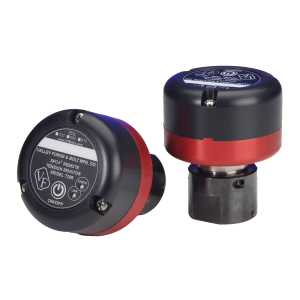
We have thousands of tension verifying bolts now installed worldwide, many of which are now coupled with our new generation of WiFi enabled remote tension sensors.
Significant efforts are being directed towards the expansion of our wireless bolt monitoring devices. We are working with a variety of wireless and internet communication technologies: all of which will provide an ability for bolted joints to be remotely monitored.
What Will Valley Forge Engineering look like going forward?”
James: Since the beginning of the year, we invested in growing our Engineering and Research Group. With additional Electrical and Mechanical Bolting Specialists who are not only trained in design, but also problem solving. Our Engineers can help both from our Phoenix HQ and in the field. We will also have platforms on additional strategic international locations.
The spring ASTM Committee F16 on Fasteners meeting was held this past week and was attended by several Valley Forge members.
The purpose of the F16 Committee, which is broken into subgroups, is to maintain, update and improve existing standards.
The various subcommittees conducted their usual business and F16 main wrapped up on Tuesday afternoon.
This report is intended to high lite some of the major issues and topics from the meetings.
ASTM F2482 Load-Indicating Externally Threaded Fasteners
During the F16-02 meeting a representative of Industrial Indicators (formally Stress Indicators) requested that a task group be formed to include their product, Smart Bolt & the “Chroma Series”, into the F2482 specification. Several years ago, F16 made a determination to reduce the number of fastener standards by grouping like product standards. Although the F2482 standard is not up for renewal until 2020, it was agreed that a task group be formed. Valley Forge was initially a principal in the introduction and the writing of this standard. It is expected that the rewrite of the standard will be divided into two (2) distinct categories. They will be the original “Measuring Type” and a “Go/No Go” type. Valley Forge will participate in the work group to insure the integrity of the standard and the clear distinction of the two (2) types.
F16.96 Subcommittee on Bolting Technology
The interesting aspect of this committee are the Technical Presentations delivered by various companies. The representative of Industrial Indicators (formally Stress Indicators) introduced their new “Chroma Series” tension indicating fastener. Unlike their Smart Bolt it requires a chromatic displacement transducer to determine if the predetermined tension has been reached. It was presented as an upgrade of the Smart Bolt with an expected accuracy of +/- 5%. To date the development is being completed, and a protoype unit was on display for inspection.
F16.97 Coordination with North American TAGs to ISO TC 2 on Fasteners
ISO TC2 on Fasteners worldwide representatives will be meeting in Montreal Oct. 15 – Oct. 19.
In the last meeting the Chinese Delegation presented an interesting item. They had wished to include in ISO 898, a product in class 8.8 & 9.8, using non-heat-treated material. They have been using this material throughout China for several years. Their attempts at 10.9 have not been successful. This concept was totally rejected by the committee. The question is “will this product find its way into North America”?
After several years of discussion, testing and review of results, ISO 4042 has been voted on and accepted. This is an electroplating specification that somewhat follows ASTM F1941 removing baking for items 360 HV and below. They however, put in a grey area between HV 360 – 390 that cautions the specification user that they may wish to consider baking. We will understand this new specification better once we obtain a printed version.
B08 Metallic and Organic Coatings
B08-06 Soft Metals
As most of you are aware there are two (2) standards within ASTM, both pertaining to electro deposited zinc. They are F1941 & B633 and they disagree at what hardness is baking to be performed. In 2007, B633 was change to make baking mandatory at RC31, grade 5 or higher. The B08-06 committee has claimed that there was work performed to support this change. They however; have not presented the supporting documents. ASTM has stated that they will not become involved to resolve the discrepancy. It must be resolved by the individual committees. The specification has now been basically rewritten and submitted for comments.
Of course, many negatives were received and an all-day work session was held on Wednesday to resolve the negatives. Basically, many of the areas of the document were rewritten and restructured to resolve the negatives. At the end of the day there still remained negatives. It was decided to once more send out the rewritten specification for a vote. The negative comments will be dealt with at the next meeting or by special action by the voting members. It is believed that the majority of the voting members will accept the rewritten standard and find the negatives “non-persuasive”. The rewriting of this standard and the removal of the requirement for baking beginning at RC31 is very important. Valley Forge has a voting member serving on this committee.