

The Latest At Valley Forge
We are happy to announce that James Brooks has joined Valley Forge as Director of Engineering and New Business Development.
James is an engineering graduate from the University of London (UK) and brings significant experience in the field of specialty engineered fastening solutions. This includes direction of a large Swedish/US specialty fastener company. In addition, he has significant experience in the development and execution of global strategies along with a long list of sales growth. We are excited that James will soon be moving to Phoenix, Arizona to our US Corporate Headquarters.
James adds, “[He is] delighted to be joining the team at VFB. Timing is great as Valley Forge has the proven capabilities to innovate and support the next generation of fasteners. Their bolted joint monitoring solutions are being increasingly sought after in many industrial market segments.”
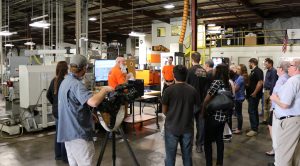
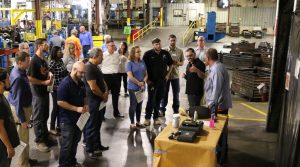
The month of October celebrates Manufacturing Month. On Friday, October 6th, we celebrated MFG Day at Valley Forge. We welcomed a variety of students and the public into the shop and had two tours of the facility. Each group toured the VF shop and had the opportunity to explore and get an in depth view of our advanced ERP System, engineering, drafting and design, large hot-headed forging, heat treat, roll threading, CNC machining and Load Indicating Technology. We also received a special visit from Todd Boppell, the COO of NAM (National Association of Manufacturers). Todd helped us to communicate the reason for MFG Day across America, to help dispel the stigma of working in manufacturing.
ABC15 News reporter John Genovese stopped by, filmed one tour and did some great interviews in the shop. VFB made the news program on Monday, October 9 with the story below.
By: John Genovese
PHOENIX – A Valley business is hoping to inspire the next generation of manufacturing workers.
“You can learn other skills and still be a valuable member of the community without having a college degree,” said Michele Clarke, CEO of Valley Forge & Bolt.
The company, which employs around 80 people and produces industrial fasteners that are shipped around the world, has been in the Phoenix-area since the 1970s.
“We make a quality product, and we stand by our product,” Clarke said.
Valley Forge is among thousands of manufacturing companies across the country offering tours this month to lure students and young people to the profession.
The National Association of Manufacturers estimates there are 500,000 open manufacturing positions in the U.S. By 2025; they anticipate an additional 3.5-million jobs will be available.
“Two-million of those are going to be unfilled if we don’t do something about the current skills gap that we have,” said NAM COO Todd Boppell.
Jose Molina, a student, was among those taking part in a tour at Valley Forge.
“There’s a lot more to it than meets the eye,” he said.
Clarke told ABC15 the business is now as much about technology as it is manual labor.
“The innovation that this country was created with can’t be lost,” she said.
Reprint courtesy of ABC15. See more here.


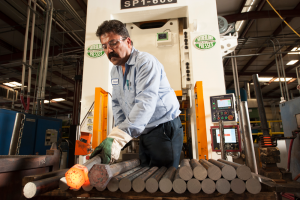 here is plenty of attention paid to the high-precision designs of advanced materials and parts developed for critical applications, but even parts that are seemingly ordinary or standard run projects require an exceptional degree of precision in concept, engineering, execution, and operation.
Valley Forge & Bolt Manufacturing Co. in Phoenix has been producing high-quality hot forged industrial fasteners for over 40 years. The manufacturer — which also has heat-treating, threading, and machining capabilities — is well known for its novel (and patented) MaxBolt load-indicating fasteners. Each MaxBolt™ fastener features a tiny, built-in gauge that continuously measures and indicates the level of tension being exerted on the bolt.
Maxbolt fasteners are manufactured by inserting highly accurate and durable load-monitoring devices into high quality bolts and studs. Accurate assembly and continuous monitoring during production reduce the potential for premature wear, expensive downtime, and catastrophic joint failure.
According to Valley Forge & Bolt, load-indicating fasteners are compatible with conventional tightening and tensioning equipment and eliminate the need for ultrasonic, strain gages, and torque measuring devices. The system offers a simple and reliable method for accurate joint assembly, and helps to maintain the integrity of the bolted joint.
MaxBolt fasteners appear simple, but are critical for the types of projects carried out by Valley Forge’s customers, including fabricating and maintaining sub-sea platforms, mining equipment, and assemblies and fabrications used in nuclear laboratories, oil-and-gas processing, construction cranes, and power plants.
In order to operate at the level of reliability and efficiency required for these high-stakes jobs, Valley Forge & Bolt also needs precision and reliability in its manufacturing operation, which is centered on a dozen or so hot-forging machines, mainly mechanical upset presses and punch presses.
Some time ago, Ron Clarke, Valley Forge & Bolt president contacted Sutherland Presses to discuss a new approach to the process of making extra-long bolts. The project continued and evolved into a multi-year collaboration, reviewing existing processes, and developing new targets for safer production and higher output.
 At an early stage of the collaboration it became clear to Clarke that Valley Forge & Bolt had an area of opportunity particularly suited to the strengths of Sutherland Presses. “The conventional forge presses we had were not ideal for long bolt heading,” he recalled. “They forced us to have more moving and rotating parts in our dies in order to load and extract the long bolts.
“When we met with the team from Sutherland, they came to the table with a fresh idea for a Front-Loading Sliding Table (FLST) Forge Press.” Since it was installed in 2013, the 600-ton vertical press at Valley Forge has become “a signature innovation,” according to Sutherland Presses. The California-based press builder has previously implemented the FLST design for manufacturers producing extra-long bolts for fasteners supplied to aerospace programs.
Valley Forge & Bolt’s Sutherland hot-forge press has been in service for several years now, successfully forging extra-long bolts.
“Due to the front-loading design, the press can be operated manually or automated,” Clarke explained about the machine’s advantages. “There’s less heat loss due to the faster heater-to-forge cycle which creates better material flow, and the precise, close-tolerance slide guide structure has improved die life.”
The extra-long bolts being produced by the FLST press go on to secure some of the most vital connections needed to build heavy industrial equipment. And, those applications are possible because of the precision design and performance, as well as the partnership formed between two industrial innovators.
Valley Forge is very proud to announce that our Maxbolt® Load Indicating Fastener Systems have passed Military Shock Testing Standard MIL-S-901D!!
The MIL-S-901D shock test is a rigid exam that means great things for our fasteners moving forward, with many different applications involving any degree of shock to the fastener while in service.
Shock Tests, Requirements for High-Impact Shipboard Machinery, Equipment, and Systems
- Specification: Testing was completed per MIL-S-901D, Lightweight, Grade B, Class 1, Type C shock testing requirements.
- Location: Testing was done by Element Material Technology in Jupiter, Florida
- Purpose: The purpose of this military shock testing is to verify the ability of shipboard equipment to withstand shock loadings that may be incurred during wartime service due to the effects of nuclear or conventional weapons.
- Load Indicating products tested:
- Standard SPC4™
- No-Standoff SPC4™
- Single Lever Maxbolt™
- Dual Lever Maxbolt™
- Mini Maxbolt™
- No-Standoff Maxbolt™
- MIL-S-901D shock test is a common requirement for shipbuilders and other companies supporting the US Navy.
Our Maxbolt™ crosstalk video demonstrates the interactions which occur between fasteners in a typical flanged piping connection. This scenario is a perfect example of the complexity of many real-life bolted joints; particularly those with gaskets.
The demonstration clearly shows the limitations inherent with torque-tightening. The resulting differences between theory and reality can be significant. Not only does torque-tightening deliver limited accuracy in terms of resulting bolt tension, but it cannot tell you what happens once the torque wrench is removed.
All conventional tightening methods except for load indicating fasteners have this limitation, in that they are only useful for initial installation, and cannot be used to provide feedback from the bolts (and the joint) after tightening. It is true that methods such as torque-tightening, hydraulic tensioning, or turn of the nut techniques can be used in various ways after the initial bolt tightening in an effort to compensate for interactions such as bolt cross-talk. However these methods all fundamentally use the same approach; repeat the same (or a variant of the) procedure used during initial tightening. In the context of torque-tightening, a common practice in industry is to repeatedly torque the bolts in a joint over-and-over until the nuts do not turn. If the nuts turn this implies that the bolt became loose during prior tightening. Obviously this information is very subjective in nature and does not provide any useful information other than some form of load relaxation or joint interaction is actually taking place.
If load-indicating bolts are utilized, as in this video demonstration, the nature and magnitude of the interactions can be quantified, and more importantly corrected for. Rather than embarking on the time-consuming process of blindly re-torquing all bolts multiple times, a more calculated approach can then be taken which targets only those bolts with unacceptably low load.
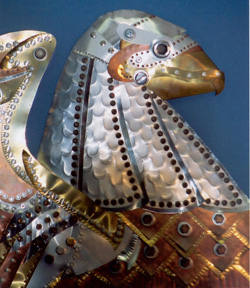 Our very own Ron Clarke has received the distinguished honor of being recognized by the Industrial Fasteners Institute for the Soaring Eagle Technology Award for 2017. He received his award at the latest IFI meeting in March. Upon acceptance, Ron of course commended the entire team at Valley Forge for receiving this award, “It takes a team to receive this sort of recognition. This award is for the entire company.”
We are extremely proud of our fearless leader for being such an innovator in the industry for over 4 decades.
“The IFI Soaring Eagle Technology Award recognizes individuals who have extensive experience in the industrial fastener industry who have made significant contributions to the technological advancement of the fastener industry. Contributions may be through extensive work on fastener standards committees, the publication of widely acclaimed principles or documents and/or through the development of fastener related equipment products, or processes which have been widely acknowledged as advancements in fastener technology.”
As taken from www.indfast.org