
Load Indicating and Innovative Bolting Technologies

The Latest At Valley Forge
Hilton Head Island, South Carolina |
Michele Clarke had the arduous task of representing Valley Forge for the IFI Fall Meeting this past September. The Industrial Fastener Institute (IFI) is an institute that was started in 1931 to service the people, industry and customer of North American Fasteners. Valley Forge has been a member of this organization for many years. The venue was The Inn at Harbour Town on Hilton Head Island – with a PGA Tournament golf course available for the obligatory and very competitive IFI Golf Tournament.
The meetings are a chance for industry professionals to discuss many of the issues that are common to all of us. We were presented with the current economic outlook by Dr. Ken Mayland of ClearView Economics, Captain Ryan Davis, USMC, lecturing on what the U.S. Marine Corp of the future will look like, a presentation on McGill University and their engineering internship program, and Dan Sharkey of Brooks, Wilkins, Sharkey & Turco PLLC on contracts and litigation in the supply-chain. We also got updated on Government Issue by Jennifer Baker Reid of The Laurin Baker Group.
The next meeting will be Spring 2016 in Phoenix our hometown!
By Ron Clark, President
It is hard for me to admit, but alas true, that I was not always the all-knowing, wonderful, omnipotent,…. in bolting matters only of course… no purple cap here… ever modest guru, that all my three followers know me as. Feeling the need to help you innocent bolting engineers…. Halley to note… that are untouched by harsh reality, I swallow my pride to bring back that nightmare window from the past in this anecdote remembering the matter of:
THAT DAM VALVE.
Looking back I can see why it took months of trial and error to fix what I considered poor design causing a simple bolt breakage problem. The valve was a large poppit style, about a foot in diameter that was driven open to allow fast approach of the slide downward and closed, to transit into pressing speed, just above the part to be trimmed. The Press would run for a few days and crash. The 16mm bolt holding the valve in place would fail. Fast approach would not slow down to pressing speed and tools would say “ouch”.
After a few failures we decided the obvious fix would be to beef up to a larger fastener and then a larger yet when that didn’t work, and at that stage, we pick up the story which continues as everything in India does, at tea time of course. I spent more time drinking tea than working, so that’s probably why my eyeballs are still yellow… anyway, there I was, drinking tea and munching Samosa’s with my good friend Erik, the plant maintenance super, discussing the latest repeat event involving… right….. you guessed it, that dam valve on my #!@%$<> (adjective) German hydraulic trim press that had crashed again, and Alberts was there. Alberts was an older bugger, a nice enough soft spoken chap….. wasn’t even a mechanic because he was only a lowly electrical supervisor, and part of his job was replacing fuses for Pete’s sake. So naturally, following the industrial caste system prevalent at that time, was considered mentally inferior….. So of course I had every right to look down on him….
By this time everyone in the forge and his brother were aware of my valve problem and maybe the whole world for all I knew. My genius reputation caused by a swollen head was in danger. Listening to our frustrated conversation while drinking tea through a monster mug, Alberts, as others before him, mildly ventured a simple fix that he had used successfully on his bicycle pump, which brought laughs and jeers from the room, along with a rude comment by me as to where he could put the fix and the pump. Because most of my problems were with German machines I remember feeling in those early days that the whole German race was against me and that they were winning. Of course this could well have been because most of the machines I installed were German anyway and I was too proud to ask the engineers at Banning who I felt would laugh at such a simple problem! I was quite young but already showing my Guru qualities in stupid.
Fast forward six months and I am at Banning, the press builder, touring our German principals from whom the company I work for import and resell machinery. I unload all my pent up Valve misery including some under my breath on Herr Joachim, the unfortunate spokesperson from their engineering department who apologetically tells me that they do not use that system any more but that they had suggested a simple fix that had I possibly not received…. Call me sensitive, but I know he was slyly laughing at me. He then showed me a sketch of the fix, which left me red faced and many hat sizes smaller. It was Alberts’ bicycle fix exactly… even including leather as the material used to absorb the shock when the valve closed. Yes SHOCK, IMPACT causing load spikes were loosening and finally fatigue failing the fastener which did not require any assembly preload. But of course you all knew this and the moral of this story is less about bolting and more about listening. A little respect for other people’s opinions can lead to good things.
In conclusion… I heard that sigh of editor relief.
As your ever knowing…. etc. .etc.. modest as always, bolting Guru I would end by mentioning a tea party on my return from the Deutschland sponsored by me.. I paid… for Mister Alberts, no less, to acknowledge his successful contribution to the institute of unaware bolting fixes and other unmentionable things and to inform him that Herr Joachim would like to hire him as head of design fixes for Banning or was it banging… can’t remember but my head size did grow back to require extra-large Mexican sombreros…
OK the end.
Presentation at Maintenance Solutions Seminar
Indianapolis, IN
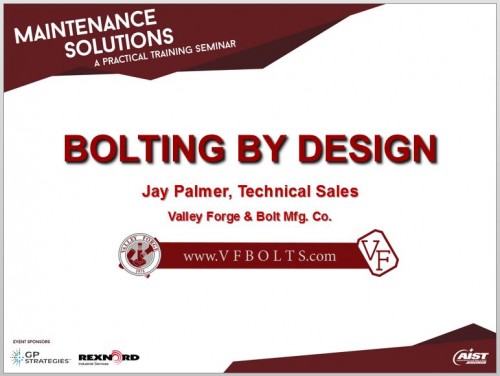
Held at the Westin Indianapolis and sponsored by the AIST Maintenance and Reliability Technical Committee, the 2015 AIST “Maintenance Solutions – A Practical Training Seminar” featured 28 events. Presented by industry leaders and subject matter experts, topics covered ‘Best-In-Class’ practices on Reliability, Hydraulics, Maintenance, Bearings, Lubrication, and Assembly of Bolted Joints.
Attended by 78 members of the Association of Iron and Steel Technology from the US and Canada, the guests were from a diverse background with a common interest in steel making.
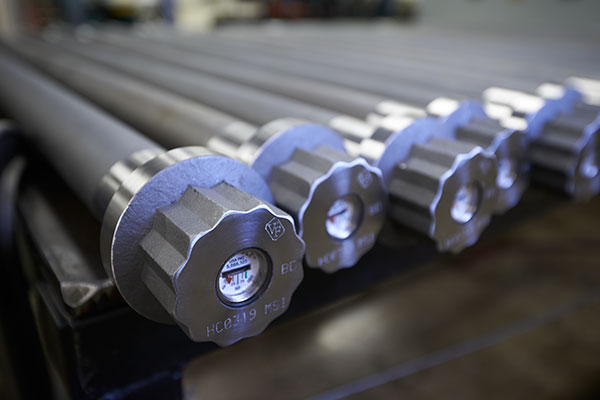
Presenting for Valley Forge & Bolt, Jay Palmer educated and informed the “Bolting by Design” session attendees on the importance of assembly, as the often overlooked and frequently most critical aspect of insuring a reliable bolted joint. By covering the quality checks involved in all the steps of fastener design and manufacturing, it is quickly evident that conventional assembly processes have the least amount of controls with the fewest measurables, for proper tension when using methods like torque. Recognizing this common deficiency in assembly methods, the ASTM created F2482. F2482, the “Standard Specification for Load-Indicating Externally Threaded Fasteners”, takes bolt load to a higher level by creating a measurable quality standard for assembly that equals the manufacturing processes to make the bolts. To qualify for F2482, a fastener must provide a means to verify the desired clamp load upon installation and in service.
The group was very intrigued with load indicating technology as it uses elongation to precisely determine load. The need for accurate tensioning for safety and reliability is obvious and the attendees embraced the concept whole-heartedly. Numerous questions and positive feedback followed, accompanied by heads nodding in agreement. Follow-up ‘lunch and learn’ presentations are being scheduled for maintenance crews at mills.
To learn more or to get your copy of the presentation click here.
The Good, The Bad and The Ugly!
At the great Victoria in London, Barry Thomas presented “The Good, The Bad and The Ugly” to the London Forum of the Heat Transfer Society on September 17th, 2015. Barry talked about bolted joints and explained the advantages of Load Indicating Technology. He has wide experience in bolting technology going back to 1972, including specific experience in the oil and gas industry and applications in structures, mechanical equipment, cranes and pressure vessels. If you happen to be in London make sure to stop by!!
Our newly installed “Heat Treat” department has settled into full production mode. Forecasted production schedules are being predictively met. To insure continuous throughput, operator training is now underway. We have incorporated Metal Training Institute (MTI) for our heat treat training program. We have implemented Class 100: Qualified Furnace Operator and Class 150: Heat Treat Technical Specialist (HTTC), as standard practice for our operator training. Under the supervision of Randy Stotts, we continue providing our customers with the highest of quality products while meeting their scheduling needs.
by Glenn Snowberger
ASTM International is an organization that develops and publishes consensus technical standards for 12,000 plus materials, products, systems and services. Within the many technical committees there is a specific section devoted to fasteners called the F16 Committee on Fasteners. Valley Forge has been a contributing and voting member of ASTM since 2000.
When you see a fastener with a grade identification marking, such as “BC” or “BD”, have you ever thought about what it refers to? These markings signify that the fastener has been manufactured and complies with a specific technical standard, in this case ASTM A354.
In 2002, Valley Forge recognized the importance of having a consensus standard detailing the requirements for Load Indicating Fasteners (LIFs), both the MAXBOLT™ and SPC4™. We then approached the ASTM subcommittee, F16-02, for steel bolts, nuts, rivets and washers, with a proposal to develop this standard. After discussion within the committee it was determined that a Work Task Group would be formed to develop the standard. After two (2) years and several ballots, a standard was presented to F16 for acceptance which resulted in the publication of ASTM F2482, Standard Specification for Load-Indicating Externally Threaded Fasteners.
With the publication of the standard, several companies have approached F16-02, proposing that their product be included in the specification. In the case of RotoBolt®, following discussion and comments over several committee meetings, it was determined that a Work Task Group be formed to develop a new standard. The rationale for this was that the product was an attribute (Go/No Go) type of system not offering a true measurement of bolt tension. This product informs the user, through a “finger test” method, that design tension has been reached. Subsequently, a Work Task Group was formed and work began on the standard, however, after a period of time the work was abandoned. RotoBolt® withdrew from the effort, resulting in the Work Task Group being disbanded and the Work Item Number being closed.
In 2013 the F16-02 subcommittee was approached by Stress Indicators, Inc. to ask for the opportunity to have their SmartBolt® fasteners included in ASTM F2482 standard. A presentation followed that detailed the product and how it enables the user to determine that the proper bolt tension has been achieved.
The discussions that followed centered on the question of, “Does the product measure bolt tension?” SmartBolt® was promoting the idea that the change in color is a measuring tool. There were many opinions that this product was also an attribute (Go/No Go) type of system, since the product provided a visual indication of tension being achieved. There was however a decision by the committee to assign a Work Item number and form a Work Task Group so as to move towards possible inclusion in F2482. This represented a major change in direction by F16-02, which we will explain later.
Work on the proposed changes or additions to the standard were completed and the proposal was submitted for a ballot which closed on January 20, 2014. At the May 2014 F16-02 meeting, the ballot results were presented with the negative votes being found to be persuasive. This then required that the ballot be revised or amended and then re-balloted. At the November 2014 subcommittee meeting, Stress Indicators, Inc. expressed their continuing interest in pursuing inclusion of their product in the standard. At the May 2015 meeting it was announced that the SmartBolt® work item had been withdrawn and was no longer on a ballot.
 Now as Paul Harvey said here is “the rest of the story”. You have to wonder why F16-02 would move ahead to consider inclusion of an attribute type product into a standard that clearly specifies measuring capabilities? ASTM F16 has looked at and determined that due to the large number of standards that are in publication, many of which are similar, they would attempt to combine standards wherever possible when they are subject to review. This is similar to the earlier movement to have inch and metric products covered in one (1) standard. This direction will clearly be shown with the publication of ASTM F3125 Specification for High Strength Structural Bolts, Steel and Alloy Steel in 2016. This is the inclusion in one (1) specification of ASTM A325/A325M and ASTM A490/A490M.
Because of the directional change by ASTM toward reducing and combining standards it is possible that in the future an attribute (Go/No Go) type of system for indicating fastener tension will be included in the ASTM F2482 specification. Valley Forge will continue to work to see that if this does come to be, the standard will have clear and precise distinctions showing the two (2) types of products. We will clearly advocate for the total separation within the standard so as to protect against anyone concluding that the two (2) types of products are the same and therefore equal, which they are not.