

The Latest At Valley Forge
 Hedgerow Consulting is a British company representing Valley Forge & Bolt in Europe with Barry Thomas at the helm. Barry serves as Valley Forge’s European Outlet and allows us to reach more customers across the pond and have more ability to solve bolting issues worldwide.
Barry has been bolting things together since 1972, when at 16 years old, he began a 5 year Mechanical Engineering Apprenticeship – he has been in the Oil and Gas Industry since 1977, hence this is his 40th year of specific oil and gas industry experience. Since 1988 he has specialized in sales to oil, gas and petrochemical industries across the upstream, midstream and downstream sectors, specifically to senior levels of operators, and EPC companies at design, engineering and operational levels. Whilst a large proportion and his experience is Oil and Gas he would be the first to say, “A bolted joint is a bolted joint whether metal to metal or with a gasket.”
In terms of Valley Forge’s patented load indicating fasteners, Barry’s experience in this specialty dates back to 1994. Barry has travelled globally on behalf of Valley Forge, and over the last 20 years he has worked all seven continents from Brazil north to Alaska and south east to New South Wales, then north to Sakhalin Island. He certainly has some stories to tell, so much so his children refer to him as “Uncle Albert” after the famous character in the British comedy TV series “Only Fools and Horses” – though it’s unclear if Barry was on any ships when they sank?
Typical applications Barry has had involvement with are critical bolted joints whether mechanical, structural or pressure containment……
- Static and or Rotating Equipment
- Piping
- Offshore Pedestal Cranes
- Subsea
- Wellheads
- LNG
Barry does have considerable experience in other industries such as
- Defence (Army and Navy)
- PowerGeneration, Renewables, Conventional and Nuclear
- Petrochemical
- Bridges to Structures to Foundations and Monuments
- Tower Cranes
- Heavy Engineering to Marine to Paper and Pulp
- Quarries to Civils to Mining
- Railways to Flight Simulators
 According to Barry, “load indicating bolting is an application rather than a commodity, therefore, we at Valley Forge pride ourselves in being both a bolt manufacturer and the technology leader. By understanding what bolted joint problems our clients have, we can then understand how to solve the problem. Clients have problems we solve, BUT we need to know exactly what that problem is. We also recognize a client’s need for us to be very adaptable.” Successful solutions means clients improve their “Best Practice” and one immediate benefit of that is greater reliability which will free up man hours.
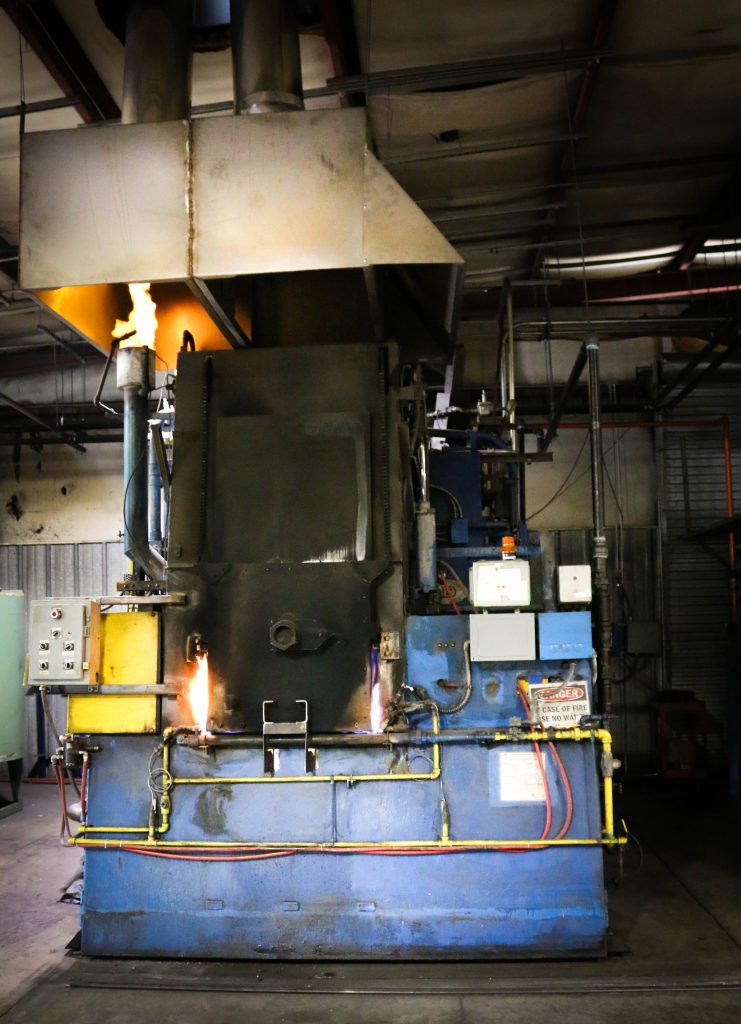
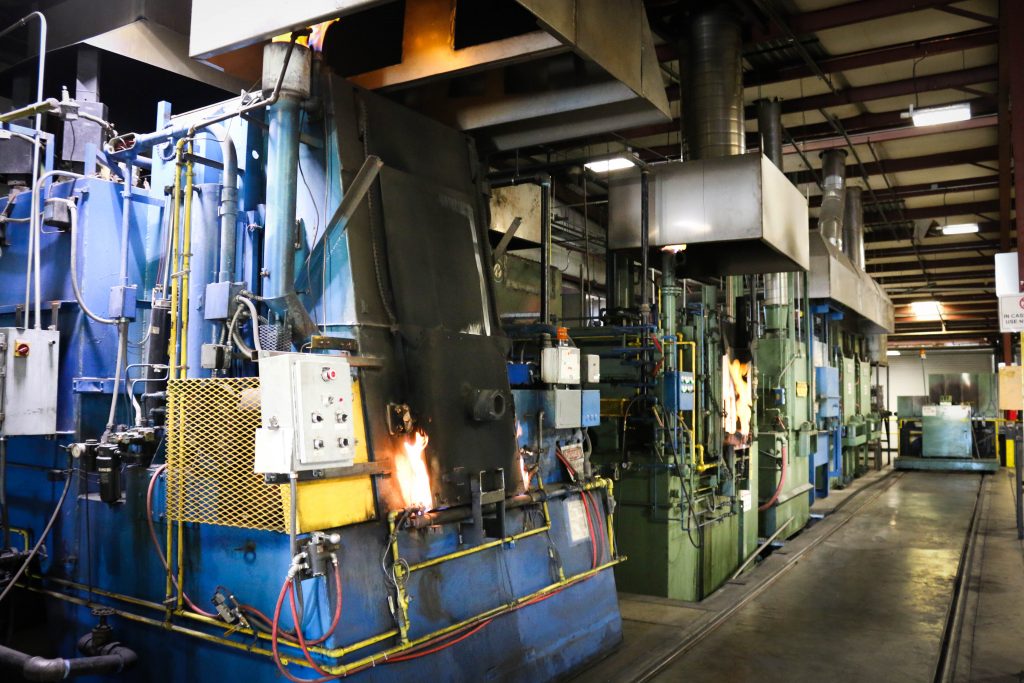
Valley Forge Bolt & Manufacturing has added some additional heat treating capacity! The Heat Treating Department has added the services of an additional Integral Quench Furnace and a gas-fired Tempering Furnace to meet the increasing production demands.
Both the new Integral Quench furnace and gas-fired tempering furnace are certified to AMS 2750.
The Integral Quench Furnace has current capabilities of processing 800-1000 pounds per load at temperatures up to 1750 degrees Fahrenheit. With the ability to load over quenched loads, greater efficiencies are realized providing maximum throughput and the ability to meet the increasing demands of production schedules and the needs of our customers!
The gas-fired tempering furnace supports the new Integral Quench Furnace providing the tempering capabilities with temperatures up to 1250 degrees Fahrenheit. The ability to rapidly achieve tempering temper set points has provided additional maximization of throughput.
All charting is documented utilizing our ssi digital tracking system and program recipes control the processing within each furnace to assure a repeatable process to the correct parameters.
We have increased our capabilities in order to better serve our customers with shorter lead times and the ability to rapidly meet those expedited needs!
We invite you to join us here at Valley Forge Bolt & Manufacturing for your bolting needs!

Fastener Crosstalk is the phenomenon where as fasteners are tensioned, they affect the load on other fasteners around them, essentially speaking to each other.
We have been wanting to make a video that can show this intriguing display for a very long time. Because the Maxbolt™ can measure continuous tension in the fastener, there is simply nothing that can show crosstalk in fasteners better.
In making this video, an actual installation was done on an ASME class 300 flange unit. All measurements were recorded precisely during tightening with 3/4″ Maxbolt fasteners and a spiral wound gasket installed. The full procedure was: (1-5-3-7), (2-6-4-8) PCC- Legacy Modified.
First Pass: Fasteners were torqued to 55 ft lbs, which targeted 22% on the Maxbolt (40% of target torque STAR)
Second Pass: Fasteners were torqued to 138 ft lbs, which targeted 50% on the Maxbolt (100% of target torque STAR)
Third and Final Pass: Fasteners were torqued to 138 ft lbs, which targeted 50% on the Maxbolt (100% of target torque CW)
Calculated with K= 0.17, 100% on MB = 26,700 Lbf
During the first pass, there was a considerable amount of crosstalk in the bolts. A the very beginning all fasteners started hand tightened, but we found many were much more loose than this as we tried to torque them. During the second and final pass though, we really see the bolts crosstalking to each other and it reflected in their tension in the video. This video animation of an actual installation illustrates that controlling a joint with torque results in uneven tensioning of the fastener because of fastener crosstalk. With Maxbolts, designed preloads can be monitored continuously and show +/- 5% of targeted load to ASTM F2482 standards.
We hope you enjoy this video as much as we enjoyed making it. Please share and stay tuned for more animations like these to see more of the Fastener Revolution.
Vancouver, British Columbia, Canada
At this year’s ASME Pressure Vessels & Piping Conference, in Vancouver British Columbia, Canada, Valley Forge’s Rusty Flocken presented results from testing performed in collaboration between Valley Forge and Shell Oil Company. FEA/FFS Specialist Dr. Gong Jung with Shell directed test efforts and offered for Mr. Flocken to co-publish and present the results as part of the annual conference.
The project goal was to significantly reduce man-hours required to complete bolt-up of a flanged piping connection while at the same time, maintaining or improving the joint’s capacity for sealing. This was accomplished by selecting a tightening pattern with the fewest moves, a torque tool capable of faster, continuous tightening, along with the use of Valley Forge’s patented SPC4™ load indicating fasteners for control and monitoring of bolt load scatter.
When tightening a flanged piping connection, it is common practice to use the Legacy tightening pattern along with a cassette-type hydraulic torque wrench. This combination is one of the longest used and most widely used methods available, and therefore was used as a bench mark against which to measure improvement. To provide the greatest improvements in time-savings and bolt load scatter, a tightening system was selected using a modification of the Legacy pattern known as the Alternative #3, along with a pneumatic torque multiplier.
Results from testing show a 15% reduction in scatter, however the time taken to perform the task was reduced by approximately 63%. In addition to the direct benefits shown, if fastener load can be monitored directly and reliably on in-service joints, using load indicating fasteners or similar tension measurement method; studies similar to this one could be conducted using option 1 presented in ASME PCC-1 for developing new alternative procedures. This would allow practical, meaningful data to be collected while reducing the risk inherent with testing new assembly procedures in the field.
The spring meeting of ASTM F16 took place the first week of May in San Antonio, Texas. F16 meets to review, update and propose new fastener standards. The meetings take place over several days, as F16 is comprised of eleven (11) Subcommittees, plus the main F16 Committee. The Main Committee meeting wraps up the Subcommittee meetings, as each chair reports on the respective meeting activities. Glenn Snowberger, as a member of F16, was in attendance representing Valley Forge.
As usual much work was accomplished in reviewing and voting on ballot issues pertaining to revising and or eliminating standards.
All changes, revisions or new proposed standards are balloted to the voting committee members. All negative ballots are discussed and voted on before any change can be initiated or any standard can be moved forward and submitted for a Main Ballot vote.
The subject of Hydrogen Embrittlement was a major point of discussion during several of the meetings. As a result of several fastener failures in the Gulf of Mexico, that were initially attributed to Hydrogen Embrittlement and then reversed, it was discovered that there are two (2) existing standards within ASTM covering Zinc Electroplating Plating that are not in agreement on the issue of at what hardness should fasteners be baked after plating. The standards are F1941 and B633, which are under the jurisdiction of two (2) separate committees, F16 Fasteners and B08 Metallic & Inorganic Coatings.
This difference is of major importance and cannot be left to exist. API ( American Petroleum Institute) and ASTM A01 have joined together in a request to have the two (2) committees find a common ground and resolved this disparity. It must be noted that B633 was changed in 2007 to require baking at hardness of RC 32 and above. Prior to 2007 it was in agreement with F1941. There are questions as to what brought about this change and what supporting studies and testing are available to support this change by B08.
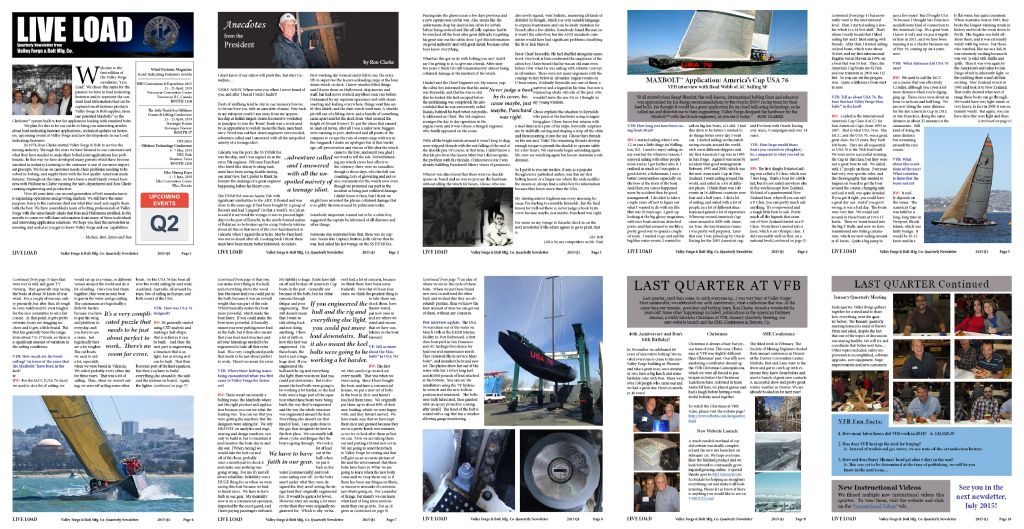
To download the full PDF version of one of our VF Newsletters: Live Load, click on the photo below.
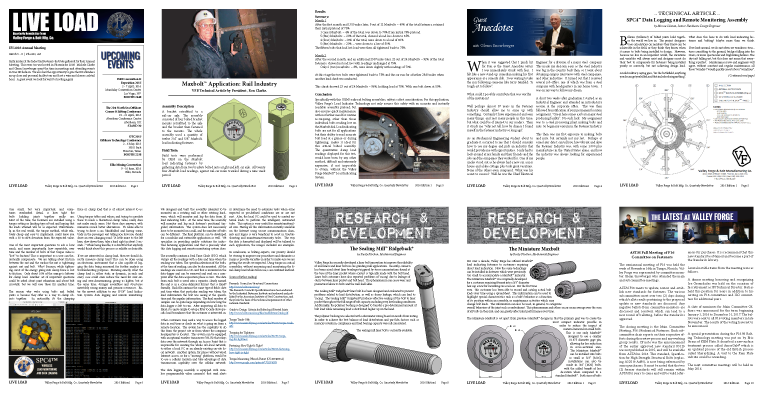
2016: Edition I (click to read)
IFI Annual Meeting
Maxbolt Application: Rail Industry
Guest Anecdotes with Glenn Snowberger
Technical Article:SPC4 Data Logging, Remote Monitoring
R&D: The Mini Maxbolt and The Sealing Mill Liner Bolt
click image to download complete pdf
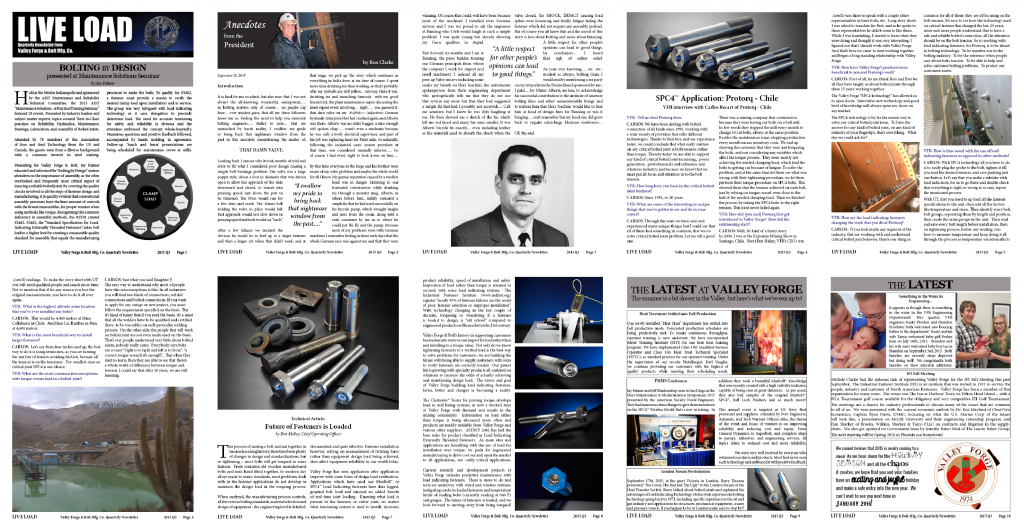
2015: Edition III (click to read)
The Future of Fasteners is Loaded
Anecdotes from the President
SPC4™ Application: Protorq – Chile
The Latest at VFB
click image to download complete pdf
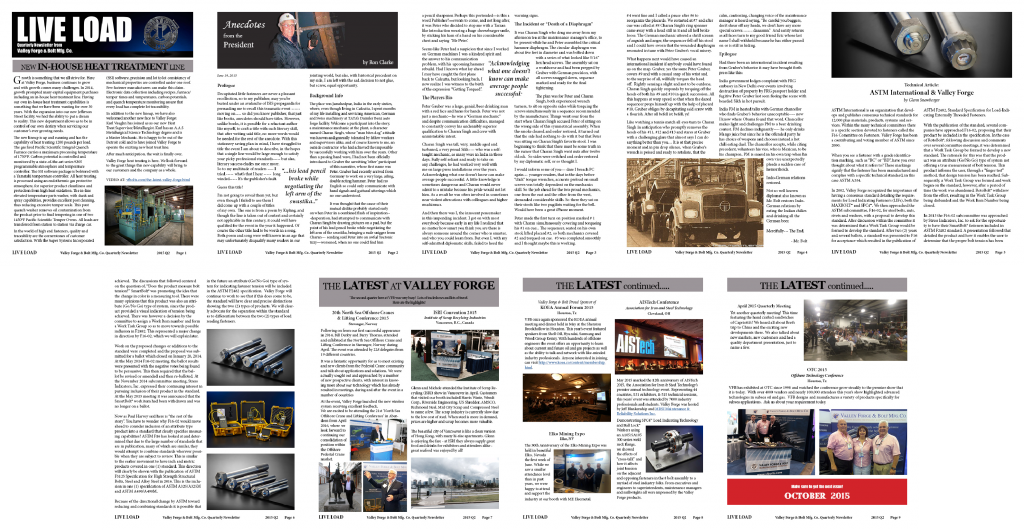
2015: Edition II (click to read)
ASTM International & Valley Forge
Anecdotes from the President
In-House Heat Treatment
The Latest at VFB
click image to download complete pdf